Friday, January 15, 2010

Batman: Amazingly Awesome

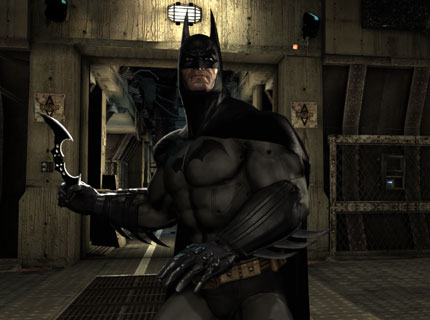
I finished Batman: Arkham Asylum a couple of nights ago, and man is that game good! I found it damn hard to fault, which is all the more impressive given that it's a pretty complex and ambitious game.

That said, I always find it interesting to think about flaws that could have been polished out, or improvements that could've been made. Games that asymptote towards perfect are, in some ways, easier to pick on, because the imperfections are more glaring.


So my biggest complaint relates to the way that the various gadgets accrued throughout the game give you access to more of the environment, or rather, that they don't tell you this is going to happen. I spent a goodly amount of time trying to figure out how the fuck I was supposed to reach only-just-inaccessible secret areas - climb to the highest point, dive off, glide down and smack into the wall just below it; fire countless Batarangs at it from all angles; place explosives on all the walls underneath it, detonated to no avail; climb around next to, above and beside it trying to find a route in - to find out, an hour or four later, that you couldn't possibly access it without the next gadget being unlocked. I know I'm not the only one, too. If Batman had muttered, "I don't think I can get in there yet - maybe later", in his impossibly gravelly voice when you encountered the first of the accused secret areas, that would've been problem solved, methinks.

Next up is the lack of variety in henchmen. There are only 9 enemy types throughout the ga- wait, that's actually a pretty respectable number. And the combat never gets boring, and every encounter is different every time, and the difficulty increases steadily throughout the game, and the presentation is fucking fantastic, and the feedback is perfect, and it's probably the best fighting system I've ever had the pleasure of fly-kicking in the head. So...yeah, it's too good, that's the problem.

No, wait! The default henchmen all have exactly the same build! The models have different textures and details and whatnot, but they're invariably enormous beefcakes, and it gets a little weird when you register that the last seven chaps whose skulls you crushed with your elbow all had exactly the same bulging biceps and tree trunk thighs. Mind you, the biceps are impeccably detailed, and you could see the pores on their shaven scalps, but it was still slightly unnerving, wasn't it? Oh.

I'm really scraping the bottom of the critical barrel.

I could complain that the acrobatic twisting that Batman has to perform in order to play the appropriate combat animation sometimes looks slightly odd, but 98.FUCKYEAH% of the time it all looks brutally lovely and flows like butterscotch sauce over a sticky date pudding. I could also point out that in the climactic moments where Batman demolishes a henchmen's face in slow-mo, the demolition boot doesn't always connect perfectly with said face, but that would be an incredibly insignificant thing to point out, and I'd look petty if I did so.


My other criticisms are more general ones. For instance, global leaderboards are demoralising because all they do is fist you with how woefully inadequate a Batman you are - a complaint that could be levelled at any global leaderboard, and which is probably highly subjective anyway because some people might look at the highest score and go, "Yeah, I can beat 1,042,249,548,129!", whereas I go, "Quit". I also semi-rail against the lameness of having Achievements associated with simple gameplay progression, whereby simply finishing the game will net you bla number of Gamerscore points (which don't mean anything except LOOK HOW BIG MY GAMERDICK IS and that doesn't matter to me at all, no sir, not at all), but really I appreciate that type of Achievement, as long as they're mixed in with inventive skill-based ones, which in the case of Batman:AA, they are. So, again, I won't bother mentioning it.

Oh, and the fight with the Joker at the end was too brief and not quite tough enough, and the camera angle buggered me about a bit, but it was thoroughly entertaining.

Yeah, that's all I got...

Sunday, January 3, 2010

Love: Loving?

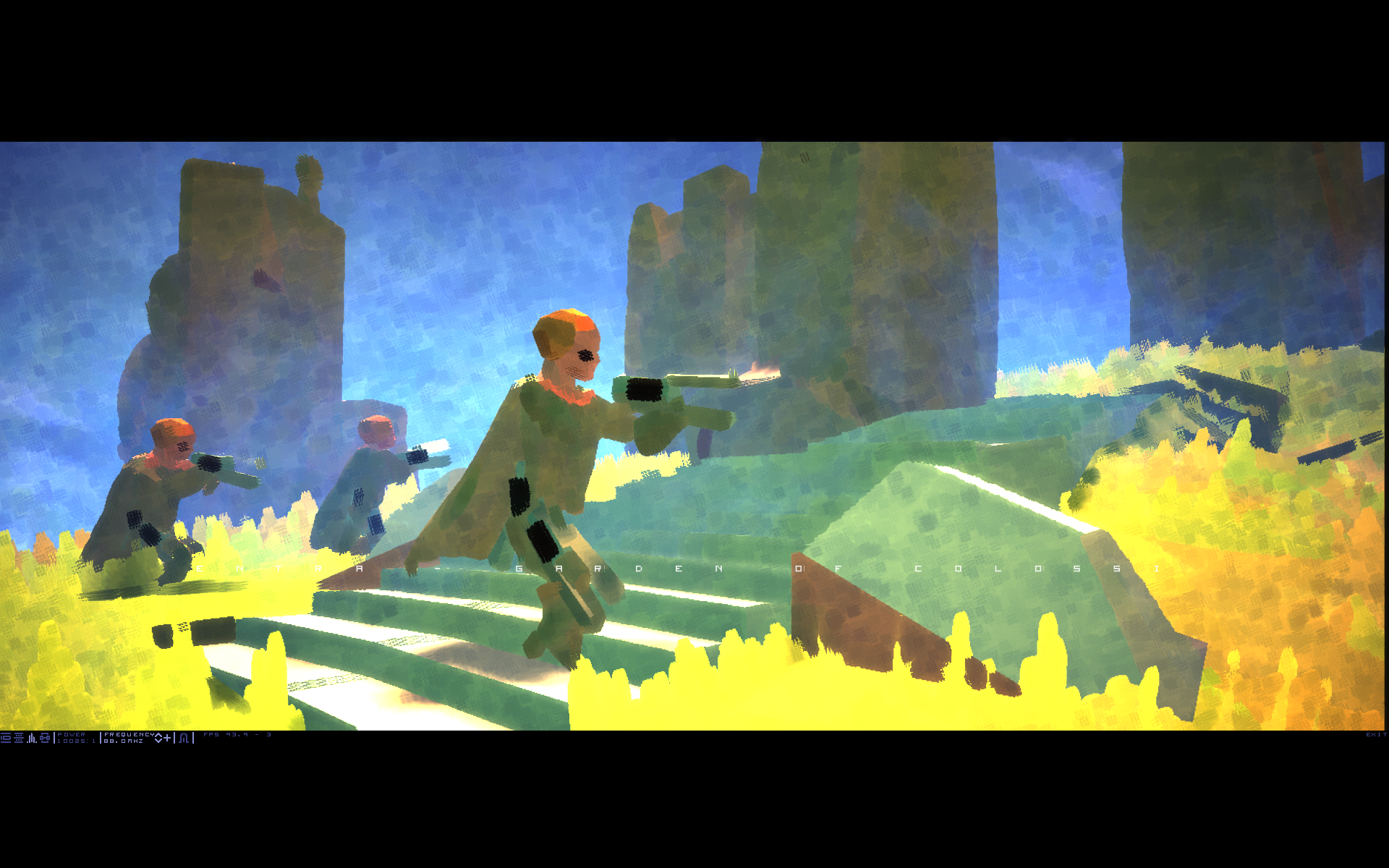
I recently came across Love. Love is "a game to play with your friends, and for them to play with their friends", and it's  being developed by a sole individual, Eskil Steenberg. I highly recommend watching the gameplay video.


It claims to be a "First person not so massively multi player online procedural adventure game" - I will now boldly state that it's the first FPNSMMOPAG. It's entering public beta on Jan 7, so soon we'll be able to put that unwieldy acronym to the test.

Essentially it looks to be a combination of Second Life, in that players can heavily influence the world and the objects in it, and Quake Wars, where you have to shut down specific parts of the base in order to take out other parts. It also has elements of The Incredible Machine, thanks to intricate links between different elements of the world, and Fracture, an ill-fated third-person shooter that attempted to pioneer use of terrain manipulation in an action game. Ooh, and perhaps any number of real-time strategy games where you have to develop a base and try to take out the opposition's.

So, basically, it's a bizarre mix of disparate genres, with a procedurally generated coating, some (hopefully) clever AI and a unique art style. I'm intrigued.


What I find particularly intriguing is the name. If I had to guess at what a game called Love was going to be like, I'd be imagining a game about developing relationships, about exploring what love is in the context of a series of game systems and rules. Perhaps that's what this game is. There certainly seems to be a lot of emphasis on cooperation, and of learning to understand each other's efforts and the environment that's being created.

That said, when he starts going on about radio frequencies, keywords, proximity sensors, weaponry, power generators and forcefields, I wonder how appropriate the name really is. Maybe it's just a ploy, a clever use of evocative language to engage people so they'll dig deeper - if so, it certainly worked on me, and now I plan on checking out the beta. If it does turn out to be a good FPNSMMOPAG, that's awesome, but if it doesn't expand on and justify the "Love" theme, I'll feel a tad betrayed.

Monday, December 21, 2009

Beneath A Steel Sky: Clever

I'm working on a sci-fi adventure game at the moment, and as part of the development process I've been "researching" 1994's Beneath A Steel Sky on my iPhone.


I finished it last night, and I'd highly recommend giving it a play - it's got some great ideas. There are sections where you enter this kind of "cyberspace", where the gameplay is very similar to other sections (use item on other item) but with a software theme - you have to perform certain commands, like decrypting documents, using "passwords" to navigate a puzzle and applying a security countermeasure to a big floating eye to stop it from logging you out when you try to access a restricted area.


You also have different keycards that gain you access to different sections of a network called "LINC" - kind of like a domain, or a BBS - and you use them to open security doors, to deliver a virus into a system, etc. At one point you have to use the capabilities of one card to gain access to an area in cyberspace, and then switch to a different card/profile in order to utilise the thing found in that area.


Another novel gameplay element is the use of the main character's robot sidekick, Joey - you have to keep retrieving his circuit board and putting it into new "shells" because they keep getting destroyed by this or that, and each shell has different capabilities. You also rely on him to get into restricted areas, and to give you advice on things you pick up, though the advice would often take the form of sarcastic condescension - good to keep things spicy.

The whole game, though far from perfect in terms of logical puzzle design, struck me as rather imaginative, especially in terms of capitalising on its "cyber" themes for advancing the gameplay. I really appreciated the fact that a single item would often gain the player access to an entire section of gameplay - you didn't often come across a random item that you picked up simply because you could, and that you would use in an obscure scenario two hours' later. There were instances of that, but overall there was a sense of cohesion in the gameplay - objects in your inventory weren't just once-off novelty things that weighed down the trial-and-error gameplay, they were a gateway into a realm of puzzle-solving possibilities.

Tuesday, December 15, 2009

Altitude: Flies

It's been well over 2 years since my last (and first) blog post, and plenty has changed since then. I've entered the games industry, first as QA and then as Game Designer. I've played many, many computer and video games, and failed to blog about any of them. Oh, and I finished BioShock, which I'll probably get around to discussing further at some point.

But for now I'd like to catch up on the many games I've played since. The first is a deliciously polished indie title called Altitude, which I highly recommend you grab the demo for immediately - yes, even at the expense of continuing to bask in the glory of my lexical spray.


Now that you've done whatever it was you did between reading the end of that last paragraph and the beginning of this one, allow me to describe Altitude as an online arcade 2D aerial combat game, somewhat like that old gem SubSpace (or Continuum, if you played it more recently).

Essentially, Altitude is all about dog fighting. You control a plane, viewed from the side, and you fly around shooting down other planes. The simple but powerful controls allow you to speed into a fight with guns blazing, peel off, dive to avoid incoming missiles and gunfire, swerve back into attack position and come back in to finish them off. If you wish, you can glide to the periphery of a scrum and lob in mines, angling them to catch the enemy on the run, or you can just coast on over, dropping bombs on the unfortunates below.

The effort that's been put into giving players nuanced control over their plane makes this game - without the afterburning, the stalling, the gravity-assisted manoeuvres, Altitude would have nothing. The elegance of this component forms a brilliant core for the rest of the game's mechanics.

Drifting alongside the tight controls is an energy system that forces you to choose between firing your weapons and using your afterburner. The interplay between speed of movement and offensive capability is exquisite, and the player must constantly make decisions depending on the context and the desired outcome. Coupled with the fine control of your plane, this system allows you to play very well or very poorly, and with that scope comes lasting engagement. Who would've thought that a spinoff of the 2D side-scrolling shoot-em-up could yield so much depth?

Menacingly circling the delicious dog fighting are five different types of plane, each with their own weapons and handling characteristics. The Loopy, terrifying to have on your tail because of its tracking missiles, is defenceless if you manage to get behind it. The Miranda, on the other hand, can spontaneously reverse facing, affording a variety of tactical options to those able to master it. The Explodet, with floating mines that home in on you, has the profound ability to make an entire area of the map dangerous.

Each of the five planes plays completely differently, and could be likened to Team Fortress 2's classes - each has pronounced strengths and weaknesses, and succeeding with each is a matter of understanding how to exploit them. I've seen each plane type both dominate and be decimated - it's just a matter of the player's skill.

Furthering the diversity of the planes is a "perks" system, much like that popularised by the recent Call of Duty games, whereby each plane has three different perk slots: weapon, defence and energy. The latter two perks are shared between the five types, while the first is specific to each type. These choices have a significant impact on the capabilities of the build, adding further flavour to your own playing style and to the shape of the threat posed by your opposition.


Ominously hovering overhead is a healthy variety of game modes. Beyond the Free For All and Team Deathmatch modes, a few more complicated variants exist, like Plane Ball, where you have to shoot a ball into the opponent's goals, and Team Base Destruction, in which you must drop bombs on the enemy base. Every mode is entertaining for different reasons, but personally I can't go past the testicle-scraping excitement of a good round of Plane Ball, with the ball being passed from plane to plane, intercepted, left floating after a massacre and then furiously swept up again when the reinforcements arrive.

Swooping about the place like a pack of enraged parakeets is a sizeable selection of maps, most of which provide an excellent mix of open spaces and tightly bunched terrain to facilitate different styles of engagement. It can be difficult to distinguish between the parts of the map that are solid and the parts that aren't - the foreground and background - but most of the time it's obvious. Strapped to the game's underbelly is a map editor and a server executable, so you can bash out your own maps and then host them for all and sundry to enjoy.

Finally, turning Altitude into an aerial arsenal of awesomeness, is an XP system that has you gradually unlocking plane types, perks and Challenges (Achievements/Trophies) over the course of 60 levels. This gives you the opportunity to become familiar with a particular plane or blend of perks, and then before you know it another option is thrown into the mix and you're off exploring its potential on the battlefield. If ever you've been soundly thrashed and are staring at the end-of-round fail screen despondently, at least you can take solace in the fact that you've edged closer to unlocking the next toy to play with.

You can probably tell that I love Altitude. Oddly, it has me swearing and thumping the desk much more frequently than any other game I can think of. I'm not sure whether it's because I'm so worked up due to the frantic pace of the action, or because of the number of mistakes I make - which is an indication of the number of mistakes I could not make, and further evidence of the game's lengthy mastery curve - but it doesn't stop me playing for at least half an hour every day.


Besides the ambiguous solidity of some parts of the terrain, the only part of the game's design I'd like to make bullet holes in is the lack of in-game help you're offered about the different plane types and game modes. For instance, I only recently learnt that the missiles fired by Explodets can be manually detonated, turning that plane type from one I routinely avoided into one I'm keen to investigate further. Also, what effect does the Loopy's EMP shot have, exactly? Dig through the game's Wiki (http://nimblygames.com/wiki/index.php?title=Main_Page) and you'll find out, but unless you do that it's guesswork

Complaints like that are outrageously, violently overshadowed by the number of things that Altitude's dev team have perfected. Considering the team is less than ten people, it's amazing what they've achieved.

I haven't really talked all that much about sound or visuals, because that's not really what this blog is about. Rest assured, though, it all looks quite nice, sounds quite good, and provides the necessary framework of sensory feedback for making the ingenious game mechanics come to life.

Oh yeah, and it works on Windows, Mac, Linux and through a browser. At the very, very least, play the demo, and if you like that, fork out the measly $15USD for the full version and give the devs a small chunk of your cash, and yourself access to the other four plane types.
Sunday, August 26, 2007

First post! Me FTW

Hi. My name is Thomas Baker. I am, among other things, an avid gamer, a freelance writer and editor, an integration aide and a reasonably human being.

No, that's not a typo - I'm an editor, remember?

I was playing through Bioshock, a game recently released by Looking Gla- err, Irrational Gam- err, 2K Boston, and I felt like I had enough opinions on it to bother starting up a blog.

So that's basically what this blog will be for - me venting my gaming spleen.


Bioshock is being hailed all across the vast expanses of the Internet as a game that advances gaming as an art form - it's supposed to combine an involving plot, a cohesive visual aesthetic and solid, enjoyable action gameplay. It's also supposed to present the player with moral dilemmas that require deep consideration, and which are intended to challenge the player's values and preconceptions about gaming, and possibly humanity.

Bioshock is also being given insane ratings: 5/5, 98/100 and A+++A+. The current average of all review scores for the PC version, according to www.gamerankings.com, is 95.6/100 - phenomenal.

Bioshock was dubbed the spiritual successor to System Shock 2 as soon as it was announced, and SS2 was good enough that I married it and had several of its babies. Hence, from the day Bioshock's existence was made known to the public, I've been sitting around, wearing a bib and waiting for its release. When the demo came out I damn near brained myself with excitement. I sat watching it transfer, twitching and laughing nervously. My hype-gland was visibly throbbing.

I'm sure you get the picture - I was looking forward to this game. And don't get me wrong: I've purchased the full version via Steam, and I've played the first couple of hours, and I freaking love it. But in my eyes it's failed on a few vital points.

SPOILER WARNING (although if you've played the demo you'll already have witnessed the elements of Bioshock that I'm about to discuss, so soldier on if that's the case)

The game starts with your character's plane crashing near a surface-level entrance to Rapture, the underwater city that plays host to the game proper. That's not my concern - it's a fairly feasible way for the character to end up in the game's environment. This sequence is done so beautifully - I didn't take control of the character for some time because I thought I was still watching a cut scene - that I really don't mind the "Oh my, that's convenient" factor.

No, my major concern is that you're plunged into a very foreign environment inhabited by genetically modified freaks, called Splicers, and when you first come across a Plasmid - one of the gene-warping products available in the city of Rapture - the assumption is made that the player wants to leap headfirst into this DNA-corrupting lark. You're forced to use the Plasmid in order to open a door; the decision is made for you.

To rub chilli paste into the wound, gaining access to the Plasmid's juicy power-up actually requires you to take a syringe the size of a kitten and stab it into your arm. Despite the exceptionally unpleasant nature of such an act, your character knows exactly what to do, and doesn't hesitate in doing so.

The crux of my complaint is this: the developers don't give you the option, and they don't explain why. They give you options, such as which Plasmids to use and what items to buy, etc., but the assumption these options ride on is that you opted to screw with your own genetic code in the first place. The core of the diversity of gameplay rests on that assumption. For a game that supposedly challenges you to make moral and ethical decisions, that seems like a glaring oversight to me.

Beyond that, there's the frustration I feel about how the Splicers don't use the Plasmids that are readily available to you, and logically also to them. Looting their bodies will sometimes yield Eve Hypos, which you use to replenish your Plasmid ammo. Why are they carrying such things when they don't even use Plasmids themselves?

I won't comment on the presence of the Big Daddies and the Little Sisters, because I've only played a couple of hours of the game - their origin might be explained later. I'm worried that it won't, and that they'll just be interesting game mechanics instead of an integral part of a convincing fantasy world, but I'll reserve judgement.

It may seem like I'm nitpicking, but Bioshock was supposed to be an exercise in philosophy and human understanding, as well as a first-person shooter - so far I'm afraid it's been largely the latter.

A bloody good latter, mind you.